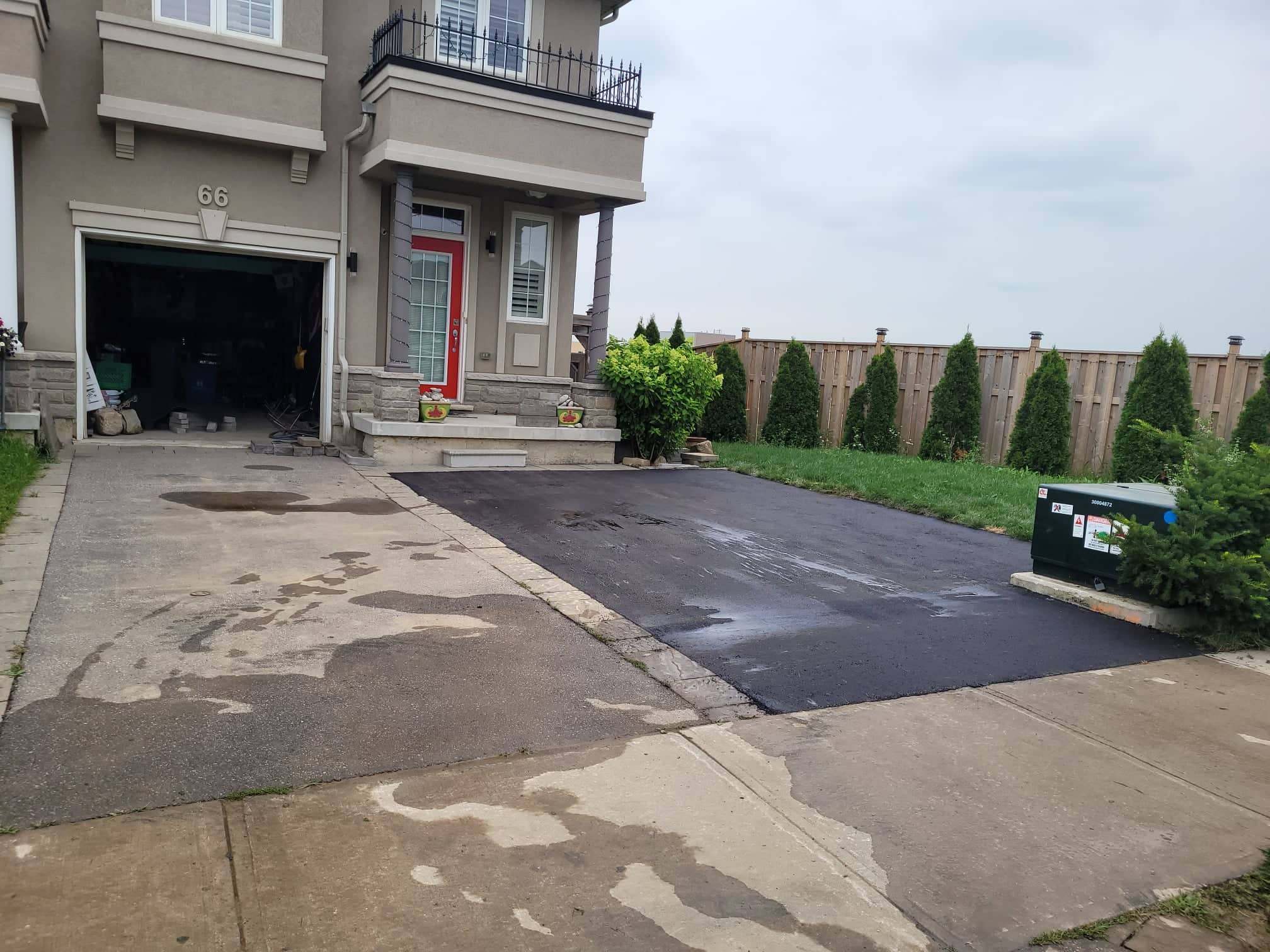
A single-car driveway stops working the day a household adds a second vehicle, a trailer, or a boat. Widening the existing driveway — rather than tearing it out and starting over — is usually the most cost-effective fix, but in Brantford it's not as simple as pouring more asphalt next to what's already there. The City regulates how wide a driveway can be, how close it can sit to the property line, and whether the curb or boulevard needs to be touched. Here's what's actually involved, from the permit desk to the final roller pass.
Why Homeowners Widen Instead of Replace
Most widening projects come from the same handful of situations: a second car that no longer fits beside the first, a driveway too narrow to open both doors without scraping a fence or garden bed, or a need to park a trailer, RV, or boat alongside the existing pad. Widening the existing surface typically costs less than a full replacement because the base and drainage of the original driveway often stay untouched — work is concentrated on the new strip being added.
Permits: What the City of Brantford Requires
Brantford treats any new or altered driveway entrance as work within the municipal right-of-way, so it's regulated, not optional. Before any excavation starts, a Right-of-Way Activity Permit needs to be approved through the City's Public Works department — it covers widening an existing driveway, installing a new entrance, and any associated curb or boulevard work. Applications must be submitted at least 15 working days before the planned start date.
The application is submitted online and needs a detailed site drawing showing the existing driveway, the proposed widened footprint, and the distance to the property line and any above-ground utilities, along with proof of commercial general liability insurance (minimum $2,000,000 per occurrence) and automobile liability insurance (minimum $2,000,000) for the contractor performing the work. A refundable security deposit of at least $2,000, plus the applicable permit fee, has to be paid before City staff begin reviewing the application.
Who to Contact
City of Brantford — Public Works, Right-of-Way Activity Permits
- Customer Contact Centre
- 519-759-4150
- service@brantford.ca
- 58 Dalhousie Street, P.O. Box 818, Brantford, ON N3T 2J2
- Apply online: Right-of-Way Activity Permit application at form.brantford.ca
Questions about an existing permit amendment, renewal, or extension go to roadclosures@brantford.ca, and questions specifically about Municipal Consent go to MunicipalConsent@brantford.ca. We handle this submission as part of our process for clients who'd rather not deal with it directly, but you're welcome to call the number above with questions before applying.
How Wide Can Your Driveway Be? Regulations by Property Size
Unlike some neighbouring municipalities, Brantford doesn't publish a table of maximum driveway width tiered by lot frontage. Instead, width is controlled by a flat percentage-of-frontage cap, a maximum width at the curb, a zoning minimum, and a set of setback rules that apply to every residential lot regardless of size:
| Requirement | Standard |
|---|---|
| Maximum driveway width at the public portion of the road (curb) | 9.1 m (30 ft) |
| Maximum driveway coverage of the lot's frontage | 50% of frontage |
| Minimum driveway width in all Residential Zones (Zoning By-law 124-2024, Section 5.7(h)) | 2.4 m (7.9 ft) |
| Minimum setback from side property lines | 1 m (3.3 ft) |
| Minimum setback from above-ground utilities (hydrants, Bell boxes, hydro poles) | 1 m (3.3 ft) |
| Clearance from City-owned boulevard trees | 1–3 m (3.3–9.8 ft), subject to Forestry Dept. review |
A few other rules matter just as much as the numbers above:
- Right-of-Way Activity Permit applications must be submitted at least 15 working days before work is scheduled to begin.
- Saw-cutting an existing curb to create a new driveway drop or curb access is not permitted — any new or widened curb cut has to be built to Public Works' own drop-curb specifications.
- A separate Site Alteration Permit may also apply if the work involves significant grading or new hard surface on a lot of 0.405 hectares (1 acre) or larger.
- The refundable $2,000 minimum security deposit is held until the City confirms the boulevard and curb have been restored to standard after the work is finished.
These figures come from the City of Brantford's Right-of-Way Activity program (Public Works) and the Comprehensive Zoning By-law 124-2024, and both can be revised by Council, so we always confirm the current requirements for your specific address with Public Works before finalizing a design — the figures above are a starting point for budgeting, not a substitute for the City's sign-off.
In practice, the application review checks sightline safety at the street, drainage impact on the boulevard, and conflicts with buried or above-ground utilities before issuing approval. Processing takes a minimum of a few weeks once the 15-working-day submission window and staff review are factored in, so this step should happen before you book a paving crew — not after. Corner lots, driveways near a hydrant or utility pole, and properties with mature boulevard trees tend to need extra scrutiny and sometimes a site visit from the City.
Step 1: Site Assessment & Measurements
We start by measuring the existing driveway, the lot frontage, and the distance to the property line on both sides. This tells us how much width can legally be added and lets us sketch the footprint that goes into the permit application. We also check the slope of the existing surface so the new section ties in at the same grade — a mismatch here is what causes ponding along the seam later.
Step 2: Permit Application & Utility Locates
With the sketch finalized, we submit the Right-of-Way Activity Permit application to the City on your behalf, at least 15 working days ahead of the planned start date. While that's processing, we file a locate request through Ontario One Call so that gas, hydro, and telecom lines near the widened area are marked before any digging happens. Both steps need to clear before equipment shows up on site.
Step 3: Saw-Cutting & Excavation
Once approvals are in hand, we saw-cut a clean, straight edge along the existing driveway surface where the new section will tie in — this gives a sharp seam instead of a ragged, hand-broken edge. The widening area is then excavated to the same depth as the original driveway, typically 8–12 inches for a residential asphalt driveway in our climate, and any soft or unstable soil is removed and replaced with compactable fill. Any work touching the curb itself follows the City's own drop-curb specifications rather than a simple saw cut, since Brantford doesn't permit sawing an existing curb to create a new driveway access.
Step 4: Base Preparation & Compaction
A Granular A sub-base is placed in the excavated strip and compacted in lifts with a plate compactor or vibratory roller, matching the depth and compaction of the existing driveway's base. This is the step that determines whether the new section settles evenly with the old one over the next few winters — skipping it or thinning it out is the most common reason a widened section cracks away from the original driveway within a couple of years.
Step 5: Paving or Concrete to Match the Existing Surface
For asphalt driveways, hot-mix is laid and compacted across the new strip at the same thickness as the original surface, with the seam rolled carefully so it bonds rather than just butts up against the old edge. For concrete driveways, new forms are set, reinforcement is placed if required, and the pour is finished to match the existing surface's texture — broom finish, exposed aggregate, or stamped — so the addition doesn't look like an obvious patch.
Step 6: Curb Cut, Boulevard Restoration & Final Inspection
If the widening required a new or extended curb cut, that work is completed to Public Works' drop-curb standard, including any required culvert or drainage adjustment under the boulevard. Disturbed boulevard areas are regraded and restored with sod or seed. The City holds the security deposit until it confirms the boulevard and curb are restored to standard, and may inspect the finished entrance before closing out the permit file. We walk the site with you at the end to confirm the new section's grade, width, and finish match what was approved.
How Much Does Driveway Widening Cost in Brantford?
Two separate costs are in play: the City's permit fee, and the paving contractor's cost for the physical work.
Permit fees. Under the City's 2024–2027 Fees and Charges Consolidated Schedule, the Right-of-Way Activity Permit application fee is $122.04 for 2026 (up from $119.65 in 2025), with a matching $122.04 inspection fee where applicable, plus a refundable minimum security deposit of $2,000. The schedule is revised each January 1, so treat these as reference figures and confirm the exact current amount with Public Works — contact info above — when you apply.
Construction cost. This depends mainly on how much additional width is being added, the material (asphalt is generally less expensive than concrete per square foot), and whether curb or boulevard work is involved. Because the existing driveway's base and drainage are usually left in place, widening is typically less expensive per square foot than a full driveway replacement of the same total size. A site visit and written quote is the only reliable way to price a specific project.
How Long Does the Whole Process Take?
Permit review is usually the longest part of the timeline — applications must be submitted at least 15 working days ahead of the work, and actual review can take longer depending on the City's current volume and whether a site visit is required. Once approvals are in hand, the physical work — excavation, base, and paving — is typically completed within a day or two for a standard residential widening, with asphalt driveways needing 24–48 hours before vehicles can drive on the new section and concrete needing longer to cure before it can bear weight.
Thinking About Widening Your Driveway?
We handle Brantford driveway widening projects from permit application through final paving. Contact us for a free site visit — we'll measure your lot, walk you through what the City will require, and give you a written quote within 48 hours.
Get a Free Estimate Driveway Paving Service