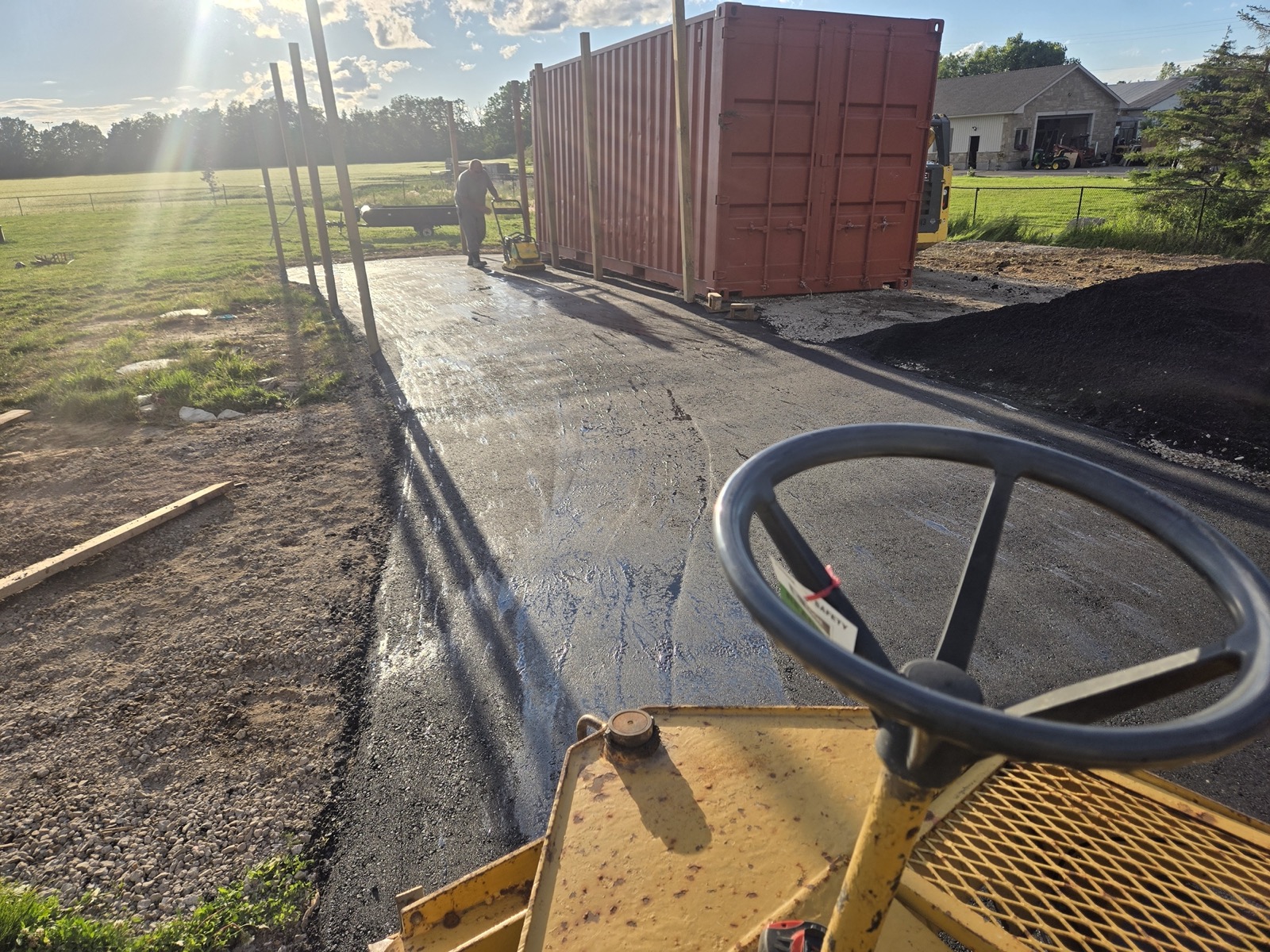
Out past the city grid, a lot of properties still get to the house on a gravel laneway. Think Flamborough, Ancaster, Glanbrook, Waterdown, the Niagara Escarpment, and the rural edges of Grimsby and West Lincoln. Paving one of these is a different job than a 20-foot city driveway. It might run 200 feet from the road. Or ten times that. Here's how the process actually works, and what changes when a driveway is long and rural instead of short and urban.
What Makes a Rural Driveway Different
A few things set a long rural driveway apart from a standard urban one:
- Scale. Urban jobs add a few feet of width. Rural laneways run hundreds, sometimes thousands, of feet long. That changes the material volume and how many days the crew is on site.
- No curb, no City crew. In town, the City often builds the piece that crosses the boulevard. On a rural road, the driveway meets an open ditch. The culvert under the entrance is usually the owner's job to install.
- Heavier loads. Oil trucks, propane trucks, farm equipment, and snowplows all put more stress on a rural entrance than everyday car traffic.
- More than one possible authority. The road out front could be a township road, a Regional Road, or rarely a provincial highway. Each has its own permit process.
Permits & Approvals
A rural driveway needs sign-off before work starts. The road authority — a local township, a Region like Halton or Niagara, or rarely the Ministry of Transportation — reviews the entrance and culvert plan. If the route crosses a creek or wetland, the local conservation authority reviews it too, and that review can take months.
Culvert size and platform width vary by road authority. As a rough benchmark, a rural entrance commonly needs a culvert around 400–500 mm (15.7–19.7 in) wide and a platform about 6 m (19.7 ft) wide. The exact numbers come from your road authority's approval letter, not a general rule, so we confirm the real spec before we price a job.
Not sure which road authority applies to your property? Contact us and we'll confirm it for you →
Step 1: Walk the Full Length
We walk the entire driveway, not just the first 50 feet. We check the ditch line, the existing culvert, grade changes, soil, trees, and utilities. Conditions can change a lot over a long run, and this walk sets the plan for base depth and drainage.
Step 2: Permits & Locates
We submit the entrance and culvert plan to the road authority. We also file a locate request with Ontario One Call for the full length of the driveway. Both have to clear before equipment shows up.
Step 3: Culvert Installation
The culvert goes in at the road entrance, built to the approved spec. It stays uncovered for inspection before it's backfilled. We hold off on finishing the backfill until the heavy equipment phase is done, so a loaded truck doesn't crush it too early.
Step 4: Clearing & Grading
We clear and rough-grade the full length. We keep a steady crown and cross-slope the whole way, so water sheds into the ditches instead of pooling. Low spots are easy to miss here, and the most expensive thing to fix later.
Step 5: Base Install
This step decides how long the driveway lasts. We place granular base in the excavated strip and compact it in lifts. A typical urban driveway base runs about 6 in (150 mm) deep. A rural driveway built for trucks, equipment, and snowplows usually runs 8–12 in (200–300 mm) deep, placed in two or three compacted lifts rather than one. Soft clay sections — common across the escarpment and into Niagara — can need even more depth.

Step 6: Asphalt Install
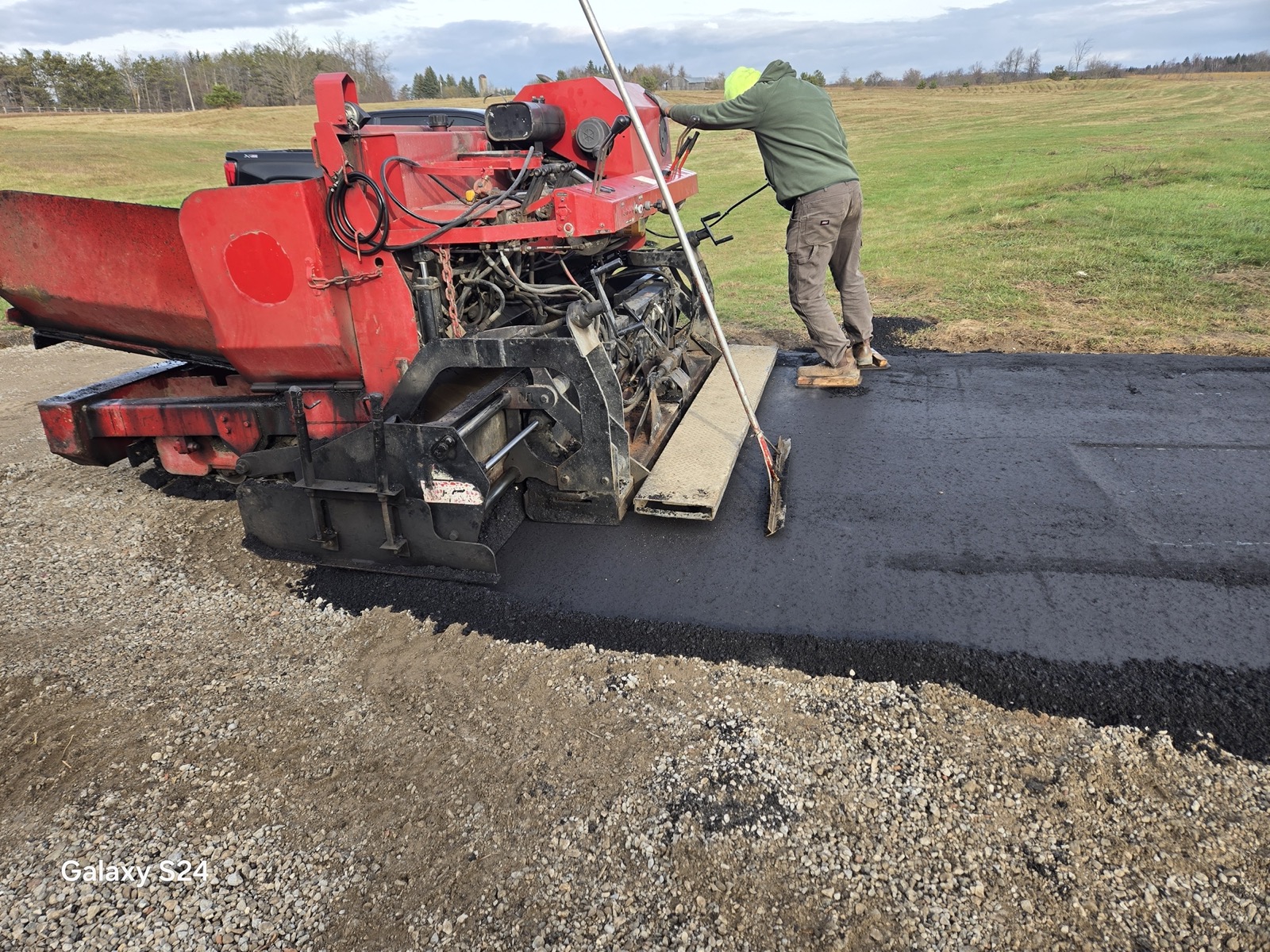
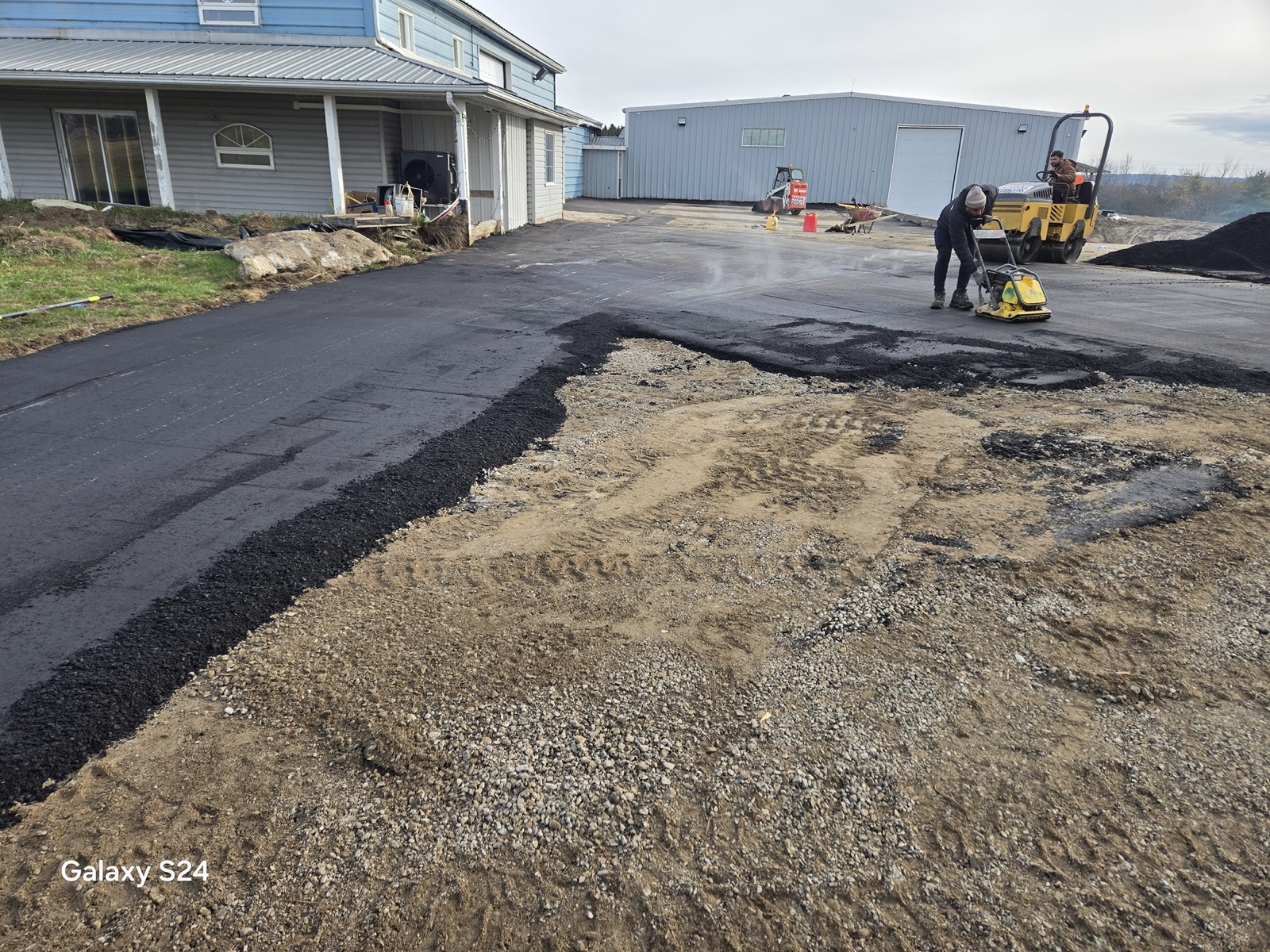
Hot-mix is delivered by the truckload and laid in sequence. A long driveway is usually paved in passes over one or more days, not in a single visit like a short urban driveway. Asphalt depth scales with the load too. A typical urban driveway gets 2.5–3 in (64–76 mm) of asphalt in one lift. A rural entrance built for trucks and equipment is usually paved 3–4 in (76–100 mm) thick, often in two lifts — a binder course, then a surface course. Each section is rolled and compacted while it's still hot.
Step 7: Shoulders & Final Inspection
There's no curb on a rural driveway. The edges get gravel shoulders instead, and any disturbed ditch is regraded. Turnarounds, if included, are finished at this stage. The road authority inspects the entrance and culvert before signing off.
How Long Does It Take?
Permits set the pace, not the paving. Entrance permit review usually takes a few weeks. A conservation authority review, if one applies, can take months — start that conversation early if a creek or wetland is nearby.
Once permits clear, the physical work moves fast by comparison. A long driveway usually takes several days to a week, versus a day or two for a short urban one. Weather matters more too — a longer driveway needs a longer stretch of good paving weather to finish in one push.
What Drives the Cost
Length and area drive most of the cost. Beyond that: whether a new culvert is needed, how deep the base and asphalt need to go, and whether a conservation authority permit applies. A site visit is the only reliable way to price a specific driveway — length alone doesn't tell the whole story.
Want an exact number for your driveway? Get a free estimate →
Have a Long Rural Driveway to Pave?
We handle rural paving projects across Hamilton, Burlington, Oakville, Grimsby and the surrounding countryside — from entrance permits and culvert installation through to final paving. Contact us for a free site visit — we'll walk the full route, confirm which road authority and permits apply, and give you a written quote within 48 hours.
Get a Free Estimate Driveway Paving Service